Time: Jul 6 2026 Views: 3
INTRODUCTION
In low-temperature flue gas heat recovery systems, material selection directly determines system performance, reliability, and lifecycle cost.
The three most commonly used material categories are:
● Stainless Steel (metallic heat exchangers)
● PTFE / PFA Fluoroplastic Systems
● Fluoroplastic-Steel Composite Systems
Each represents a different engineering approach to solving the balance between corrosion resistance, heat transfer efficiency, and mechanical strength.
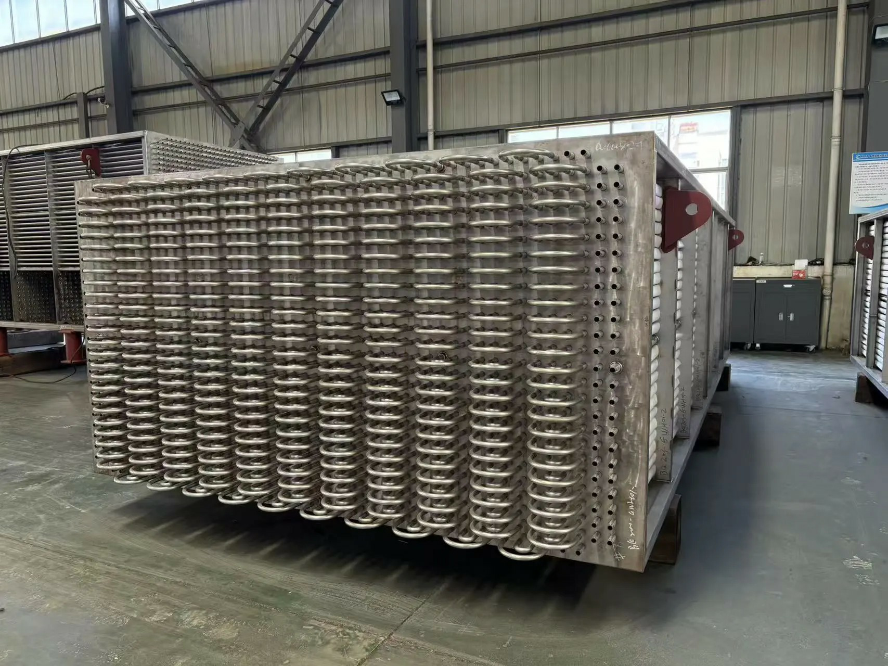
STAINLESS STEEL HEAT EXCHANGERS
Strength-Oriented Conventional Solution
Stainless steel is widely used due to its mature manufacturing and strong mechanical properties.
Advantages
● High thermal conductivity
● Excellent structural strength
● High pressure resistance
● Mature fabrication and welding technology
● Relatively low cost
Limitations
However, in corrosive flue gas environments:
● Susceptible to acid dew-point corrosion
● Surface scaling and fouling accumulation
● Performance degradation over time
● Reduced lifecycle reliability
Stainless steel is most suitable for non-corrosive or mildly corrosive conditions.
PTFE / PFA FLUOROPLASTIC SYSTEMS
Corrosion-Resistance Focused Solution
PTFE and PFA materials are used where chemical resistance is the primary requirement.
Advantages
● Excellent corrosion resistance
● Strong chemical inertness
● Non-stick surface reduces fouling
● Stable performance in aggressive media
Limitations
However, fluoroplastic-only systems have significant engineering constraints:
● Low thermal conductivity
● Limited pressure-bearing capacity
● Restricted installation (often vertical configuration only)
● Risk of long-term acid permeation
● Requires auxiliary systems (circulation, dosing, etc.)
● Higher system complexity and operating energy consumption
● Limited outlet temperature flexibility
These limitations restrict their use in high-efficiency industrial heat recovery systems.
FLUOROPLASTIC-STEEL COMPOSITE SYSTEMS
Balanced Engineering Solution
This technology integrates:
● Fluoroplastic corrosion-resistant layer
● Steel structural load-bearing core
Advantages
● Excellent corrosion resistance
● High mechanical strength
● Pressure capability up to industrial requirements (up to 2 MPa)
● Flexible installation (horizontal + vertical)
● Low flue gas resistance design
● Stable long-term operation
● Extended service life (15–20 years fluoroplastic stability)
ENGINEERING COMPARISON
Key Performance Overview
SYSTEM SELECTION LOGIC
How to Choose the Right Material
Stainless Steel is Suitable When:
● Corrosion risk is low
● Cost is a primary concern
● High thermal conductivity is required
● Operating conditions are stable above dew point
PTFE / PFA Systems are Suitable When:
● Extremely corrosive conditions exist
● Pressure requirements are low
● System simplicity is not critical
● Vertical installation is acceptable
Fluoroplastic-Steel Composite Systems are Suitable When:
● Acid dew-point corrosion is a critical risk
● Deep heat recovery is required
● Long-term operational stability is required
● Both corrosion resistance and mechanical strength are needed
KEY ENGINEERING INSIGHT
No Single Material Is Universally Optimal
Each material solves a different engineering priority:
● Stainless steel → strength and thermal conductivity
● PTFE / PFA → corrosion resistance
● Composite system → balanced system-level performance
Therefore, selection must be based on system conditions, not material preference.
CONCLUSION
Material selection is a core decision in heat recovery system design.
Understanding the trade-offs between stainless steel, PTFE/PFA systems, and fluoroplastic-steel composite technology enables engineers to:
● improve system reliability
● maximize heat recovery efficiency
● reduce lifecycle cost
● avoid corrosion-driven failures

@ 2025-2026 Langteng Machinery. All Rights Reserved.